
ARRL DX Century Club (DXCC) Rules — 1955 Edition
ARRL DX Century Club (DXCC) Rules — 1955 Edition
(Effective May 1, 1955; augmenting the 1954 rules)
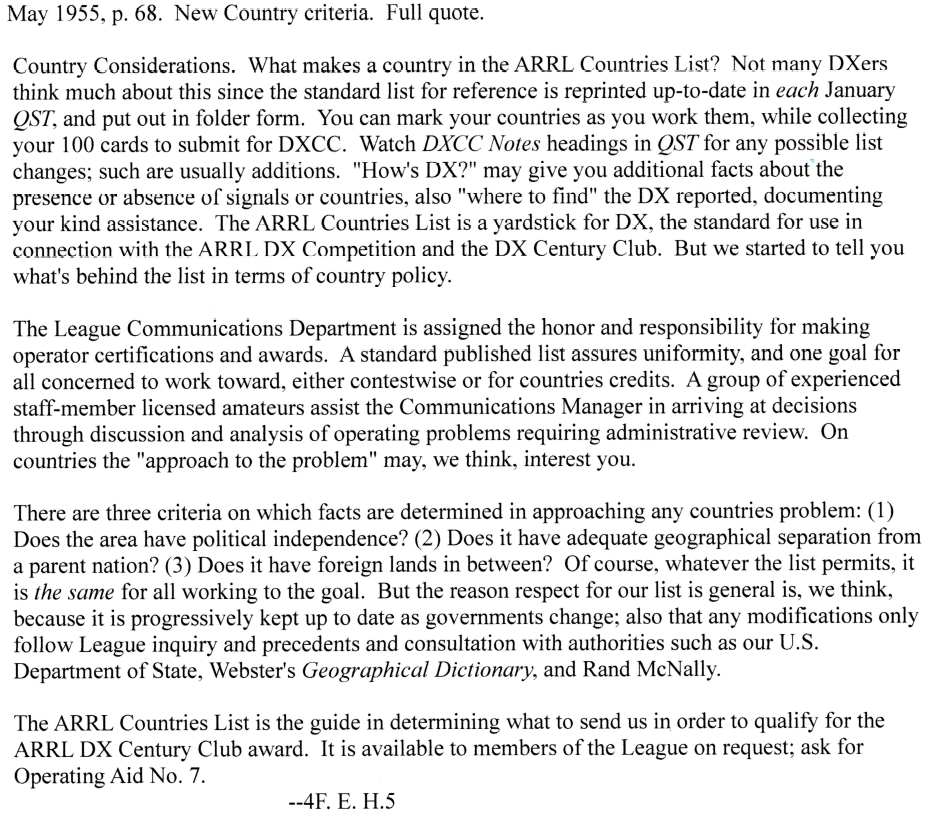
1955 DXCC Rules Change
Source: QST, May 1955, p. 68
Section Title: New Country Criteria
Summary of Change
In May 1955, the ARRL formally articulated a three-factor evaluative framework for determining what constitutes a “country” for DXCC purposes. This represents one of the earliest explicit policy statements defining DXCC entity qualification beyond informal precedent.
New Criteria Introduced (1955)
The ARRL identified three primary considerations to be applied when evaluating DXCC country status:
-
Political Independence
-
Whether the area possesses political independence from a parent nation.
-
-
Geographic Separation
-
Whether the area has sufficient geographic separation from a parent country.
-
-
Intervening Foreign Territory
-
Whether foreign lands exist between the area and the parent nation.
-
Key Policy Clarifications
-
These criteria were not presented as rigid rules, but as guiding principles for administrative decision-making.
-
The ARRL emphasized that:
-
The DXCC List is a “yardstick for DX” and a standardized reference for awards and competition.
-
Decisions are made through:
-
Discussion and analysis of operating conditions
-
Administrative review by experienced amateurs
-
-
The list is continuously updated to reflect geopolitical changes.
-
-
External authoritative sources were cited in decision-making, including:
-
U.S. Department of State
-
Webster’s Geographical Dictionary
-
Rand McNally
-
Interpretive Significance
This 1955 statement is important because it:
-
Establishes the first clearly documented DXCC eligibility framework
-
Confirms that DXCC qualification was based on a combination of political and geographic factors, not solely sovereignty
-
Introduces the concept of “adequate geographic separation”, which later evolves into formal distance-based rules (e.g., 350 km standard)
-
Demonstrates that precedent and administrative judgment were integral to DXCC decisions
Impact on Later Rules Development
The 1955 criteria directly influenced:
-
Later formalization of geographic entity rules
-
Development of island separation standards
-
Continued reliance on case-by-case administrative interpretation, which persisted until more structured rules were introduced in later decades
Historical Context Note
The 1955 criteria reflect a transitional phase in DXCC policy:
-
Moving from informal precedent-based decisions
-
Toward a more structured, criteria-driven evaluation system
However, the absence of strict thresholds (e.g., fixed distance requirements) meant that interpretation remained flexible, contributing to inconsistencies that later rule revisions attempted to resolve.
Citation
“Country Considerations. What makes a country in the ARRL Countries List? … There are three criteria on which facts are determined in approaching any countries problem: (1) Does the area have political independence? (2) Does it have adequate geographical separation from a parent nation? (3) Does it have foreign lands in between?”
— QST, May 1955, p. 68