
Synthesis & Meta-Analysis
DXCC Rules Evolution: 1988–2000
I. PURPOSE
This section reconciles two perspectives regarding the evolution of the ARRL DXCC Rules from 1988 through the development of the DXCC2000 framework:
-
The analytical conclusion that the DXCC program operates as a hybrid system that cannot be reduced to a purely deterministic rule set
-
The original design intent of the DXCC2000 framework, as described by participants in its development, to clarify and standardize the application of the 1988 Rules rather than replace the system
The objective is to align these perspectives into a consistent interpretation supported by both historical evidence and documented design intent.
II. POINTS OF ALIGNMENT
A review of the DXCC2000 development materials and subsequent analysis reveals substantial agreement on several foundational points:
1. The DXCC2000 Effort Was a Refinement Initiative
The framework was developed to address ambiguity in the application of the 1988 Rules, particularly in response to proposals for new entities that met the literal wording of the rules but not their intended meaning. The objective was to reduce subjectivity and improve consistency, not to redesign the DXCC system.
The DXCC2000 framework was designed not merely to clarify criteria, but to transfer political qualification authority from ARRL interpretation to internationally recognized external lists (UN, ITU, IARU).
2. External References Were Intended to Reduce Subjectivity and Improve Consistancy
The introduction of a structured qualification approach based on United Nations membership, ITU prefix allocation, and IARU representation was intended to shift political determination away from internal ARRL interpretation and toward recognition by established international bodies. These references were applied in a hierarchical manner, with each serving as a successive qualification path rather than co-equal criteria.
This approach provided a more consistent and repeatable method for evaluating new entities.
The framework intentionally shifted political determination away from ARRL and toward recognition by established international bodies.
3. Geographic Criteria Remained Stable
Distance-based geographic criteria were retained without substantive change. The adoption of metric equivalents and internal classifications did not alter the underlying framework, which continued to rely on fixed separation thresholds.
4. Grandfathering Was an Explicit Design Element
The retention of existing DXCC entities, even where they did not meet newly refined criteria, was not incidental but intentional. The DXCC2000 framework preserved the historical list while applying updated criteria to future additions.
III. POINTS OF DIVERGENCE
The primary difference in interpretation arises from how the results of the DXCC2000 analysis are characterized:
1. Prospective vs. Retrospective Application
-
Design Intent Perspective:
The framework was intended for prospective use—to evaluate new entities under a more objective and structured system. -
Analytical Perspective:
When applied retrospectively to the existing DXCC List, the framework reveals significant divergence between historical entities and refined criteria.
This distinction between prospective application and retrospective reconstruction is central to understanding the structure of the DXCC program.
2. Interpretation of Non-Qualifying Entities
-
Design Intent Perspective:
The identification of entities that did not meet the refined criteria was part of an analytical exercise, and was not intended as a basis for removal or restructuring of existing entities. -
Analytical Perspective:
This divergence demonstrates that the historical DXCC List cannot be fully derived from a single deterministic rule set.
IV. RECONCILED INTERPRETATION
These perspectives are not contradictory, but complementary.
The DXCC2000 framework can be understood as:
-
Successful in its intended role of providing a structured and consistently applied framework for evaluating new entities
-
Limited in its applicability to the historical DXCC List, which reflects earlier rules, interpretations, and administrative decisions
Accordingly:
A deterministic rule framework is effective for prospective application, but cannot fully account for the historically developed DXCC List.
V. IMPLICATIONS FOR DXCC STRUCTURE
This reconciliation leads to a clear structural understanding of the DXCC program:
-
Criteria provide a consistent basis for evaluating new entities
-
Precedent preserves historically recognized entities
-
Administrative judgment resolves ambiguities and transitional cases
This combination is not transitional or accidental, but inherent to the system. This structure reflects both the historical development of the DXCC List and the practical requirements of its continued administration.
VI. CONCLUSION
The evolution from the 1988 Rules through the DXCC2000 framework demonstrates that the DXCC program is not defined by a single rule-based model, but by the interaction of criteria, precedent, and administrative judgment.
The DXCC2000 effort did not fail; rather, it clarified the limits of a purely criteria-based approach. It showed that while more objective standards can govern future additions, they cannot replace the historical foundation of the DXCC List.
This understanding provides a consistent and historically supported framework for evaluating both past and future DXCC entities.
The DXCC2000 criteria represent a deliberate shift away from internal adjudication of political status. By anchoring qualification to internationally recognized lists, the ARRL removed itself from the role of determining sovereignty or legitimacy, reducing political risk and increasing global consistency.
ARRL DXCC Rules Change Analysis
Full Arc Synthesis (1955–2025)
Concept → Enforcement → Quantification → Codification → Formalization → Stabilization → Inertia
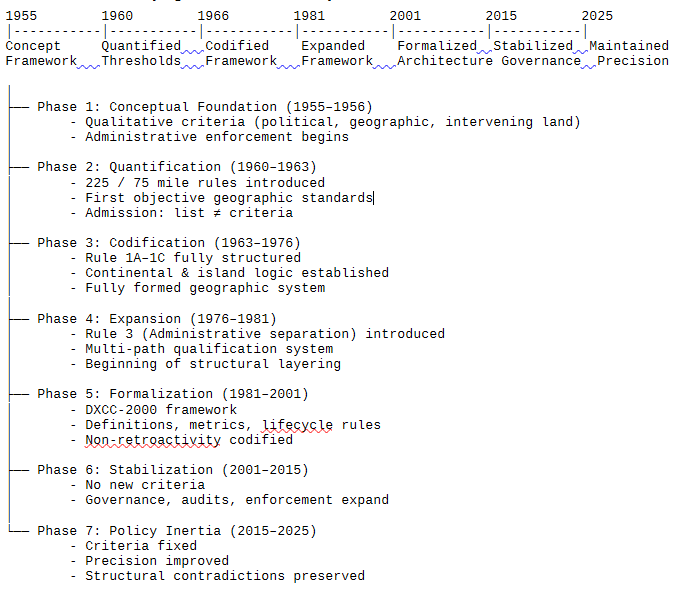
I. Visual Timeline (High-Level Evolution)
II. Structural Evolution Model
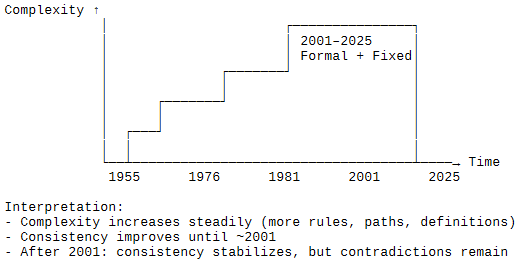
A. System Complexity vs. Consistency
B. System Character Transformation
|
Era |
System Character |
Primary Driver |
|---|---|---|
|
1955–1960 |
Conceptual |
Expert judgment |
|
1960–1976 |
Analytical |
Quantitative rules |
|
1976–1981 |
Layered |
Multiple qualification paths |
|
1981–2001 |
Formalized |
Structured criteria architecture |
|
2001–2025 |
Stabilized |
Governance and enforcement |
III. Three Critical Inflection Points
1. 1960 — Quantification
“Adequate separation” becomes measurable
-
First objective thresholds
-
Beginning of rule-based analysis
2. 1981 — Expansion
Administrative distinction becomes an independent pathway
-
System shifts from unified → layered
-
Multiple qualification paths introduced
3. 2001 — Formalization
DXCC becomes a structured criteria system
-
Definitions, metrics, lifecycle rules
-
Non-retroactivity explicitly codified
4. Post-2001 — Stabilization
System stops evolving structurally
-
Governance replaces rule development
-
Inertia begins
IV. Core Structural Model (Final State)
By 2025, DXCC operates as a three-layer hybrid system:
|
Layer |
Function |
Behavior |
|---|---|---|
|
Criteria |
Define qualification rules |
Precise, forward-looking |
|
DXCC List |
Establish actual entities |
Historical, non-uniform |
|
Precedent |
Preserve continuity |
Overrides strict rule application |
V. The Central Structural Reality
Then vs. Now
|
Aspect |
Pre-2001 |
Post-2001 |
|---|---|---|
|
Rule Evolution |
Active |
Frozen |
|
Criteria Precision |
Increasing |
Maximized |
|
System Flexibility |
High |
Constrained |
|
Governance Role |
Limited |
Dominant |
|
Structural Consistency |
Improving |
Fixed (but imperfect) |
VI. The Irreducible Tension
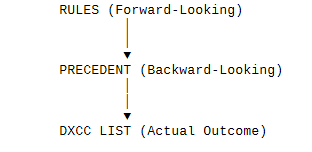
Result:
-
Rules define how new entities qualify
-
Precedent defines what remains
-
The List reflects both—and fully aligns with neither
VII. DXAC-Level Synthesis
The full arc (1955–2025) demonstrates a clear progression:
-
Framework Creation (1955–1976)
-
Framework Expansion (1976–1981)
-
Framework Formalization (1981–2001)
-
Framework Stabilization (2001–Present)
Final Insight
The DXCC system has reached maximum structural maturity—but not structural unity.
-
The rules are complete
-
The system is stable
-
The inconsistencies are permanent under current design
VIII. Direct Implication for Reform (v24q Context)
This arc leads to a single unavoidable conclusion:
Incremental refinement can no longer resolve DXCC inconsistencies.
Because:
-
Criteria are already precise
-
Exceptions are already formalized
-
Non-retroactivity prevents reconciliation
Therefore:
Meaningful reform must be structural, not incremental.
IX. One-Line Summary for Presentation Slide
“DXCC evolved from judgment → rules → structure → governance—but never achieved full internal consistency. The system is now stable, but structurally constrained.”