
Synthesis & Meta-Analysis
DXCCReconciliation Rulesof Evolution:Interpretations: 1988–2000
DXCC2000 and the Evolution of Political Qualification (1988–2000)
I. PURPOSE
This section reconciles two complementary perspectives regarding the evolution of the ARRL DXCC Rules frombetween 1988the throughlate 1980s and the development of the DXCC2000 framework:
TheEmphasisoriginaldesign-
improve consistency
-
reduce interpretive subjectivity
and -
consistency,standardize
notentity evaluation methodology -
United Nations
membership,membership -
ITU
prefixallocationsallocation, -
IARU
representationrecognitionwas -
of metric equivalents and internal classifications did not alter the underlying framework, which continued to rely on fixedoffshore separation
thresholds.thresholds -
intervening-land logic
-
island-group treatment
-
distance-based qualification
-
standardization
-
metric conversion
-
definitional precision
-
standardize future evaluation
while simultaneously: -
preserving historically recognized entities
Design
IntentPerspectivePerspective:The framework was intended primarily for prospective
use—toevaluationevaluateofnewfutureentitiesentityunderquestions.aAnalytical
morePerspectiveobjectiveWhen applied retrospectively, the framework highlights the historically layered nature of the DXCC List and
structureddemonstratessystem.that many earlier entity determinations reflected:-
prior rule structures
-
AnalyticalinterpretivePerspective:Whenadministrationapplied -
tocontinuity
the existing DXCC List, the framework reveals significant divergence between historical entities and refined criteria.preservation
retrospectivelyrather than exclusively modern criteria.
Historical Significance
This distinction
between prospective application and retrospective reconstructionis central to understanding thestructure of theDXCCprogram.system:-
prospective criteria evaluation
does not necessarily reconstruct -
historical list development
2. Interpretation of Historically Non-
QualifyingAligned EntitiesDesign
IntentPerspectivePerspective:The identificationIdentification of entities
that didnotmeetfullythealigned with refined criteria waspart of an analytical exercise, and wasnot intendedastoa basis forjustify removal orrestructuring of existing entities.
restructuring.-
Analytical
Perspective:PerspectiveThisdivergenceThe existence of such entities demonstrates that the
historicalDXCC Listcannotdevelopedbethroughfullymultiplederivedhistoricalfromframeworks rather than through a singledeterministiccontinuousrulecriteriaset.model.
IV. RECONCILED INTERPRETATION
These perspectives are not
contradictory,contradictory.butInstead,
complementary.they describe different dimensions of the same historical evolution.The DXCC2000 framework can therefore be understood as:
SuccessfulRoleFunction
Prospective framework
standardize future qualification
Historical framework
preserve continuity of existing list
Accordingly:
The DXCC2000 framework successfully increased consistency in
itsfutureintendedevaluationsrolewhileofsimultaneouslyprovidingpreserving astructuredhistoricallyandaccumulatedconsistentlyentityappliedstructureframeworkdevelopedfor evaluating new entities-
Limited in its applicabilityto the historical DXCC List, which reflectsunder earlierrules,interpretiveinterpretations, and administrative decisions-
Criteriaclearerprovide a consistent basis for evaluating new entitiesdefinitions -
Precedentimprovedpreserves historically recognized entitiesrepeatability -
Administrativegreaterjudgmentadministrativeresolves ambiguities and transitional casesconsistency -
rule evolution
-
administrative interpretation
-
continuity preservation
-
disputed sovereignty cases
-
transitional geopolitical situations
-
special administrative circumstances
-
singleformalization
rule-based -
butdefinitional
byprecision -
administrative consistency
-
historical continuity
-
precedent-based stability
-
interpretive administration
-
modern DXCC qualification methodology
and -
the continuing influence of earlier interpretive and
futureprecedential structures. -
Firstincreasedobjective thresholdsconsistency -
Beginningreducedofambiguityrule-based -
enabled structured geographic analysis
-
Systembroadenedshiftsthefrom unified → layeredframework -
Multipleincreased flexibility -
introduced a more layered qualification
paths introducedstructure -
Definitions,formalmetrics, lifecycle rulesdefinitions -
Non-retroactivitystandardizedexplicitlymeasurementscodified -
lifecycle management
-
explicit continuity preservation
-
Governancemaximumreplacesstructuralrule developmentformalization -
Inertiaimprovedbeginsadministrative consistency -
explicit non-retroactivity
-
historical accumulation
and -
modern administrative formalization
-
structural precision
-
definitional clarity
-
administrative formalization
-
historical continuity
-
precedent-based stability
-
interpretive flexibility in complex cases
-
structurally mature
-
operationally robust
-
administratively stable
-
Rulesformaldefine how new entities qualifycriteria -
Precedenthistoricaldefines what remainsprecedent -
ThecontinuityListpreservationreflects -
fullyadministrative
aligns with neitherinterpretation -
FrameworkbroadCreationconceptual(1955–1976)guidance
toward -
FrameworkhighlyExpansionformalized(1976–1981)administrative criteria -
the structure of the current DXCC system
and -
contextFrameworktheFormalizationhistorical(1981–2001)of - modern
FrameworkentityStabilizationqualification(2001–Present) The rules are completeThe system is stableThe inconsistencies are permanent under current designCriteria are already preciseExceptions are already formalizedNon-retroactivity prevents reconciliationdiscussions.
|
|
|
|---|---|
|
Historical Design Perspective |
clarification and standardization |
|
Analytical Perspective |
structural interaction of |
The objective is not to aligntreat these perspectivesinterpretations as contradictory, but rather to integrate them into a historically consistent interpretationunderstanding supportedof byhow boththe historicalDXCC evidencesystem andevolved documentedduring designthis intent.period.
II. POINTS OF ALIGNMENT
A review of the DXCC2000 development materials and subsequent historical analysis reveals substantial agreement onregarding several foundationalcore points:principles.
1. The DXCC2000 EffortWas WasPrimarily a Refinement Initiative
The DXCC2000 framework was developed to addressreduce ambiguity in the application of the 1988existing Rules,rules, particularly in responsecases where proposed entities appeared to proposals for new entities that metsatisfy the literal wording of theearlier rulescriteria butwhile notconflicting with their intended meaning.application.
The objective was toto:
rather than to redesign the DXCC system.
The DXCC2000 framework was designed not merely to clarify criteria, but to transfer political qualification authority from ARRL interpretation to internationally recognized external lists (UN, ITU, IARU).fundamentally.
2. External Political References WereReduced IntendedInternal to Reduce Subjectivity and Improve ConsistancyAdjudication
The introductionframework ofincreasingly arelied structuredupon qualificationinternationally approachrecognized basedexternal onreference systems, including:
This shiftdevelopment shifted political determinationqualification away from internal ARRL interpretation and toward recognition by establishedbroader international bodies.recognition Thesestructures.
Historical were applied in a hierarchical manner, with each serving as a successive qualification path rather than co-equal criteria.Significance
This approachrepresents providedone aof morethe consistentmost andimportant repeatableconceptual methodshifts forin evaluatingDXCC new entities.history:
The
theframeworkexternalizationintentionally shiftedof politicaldeterminationdetermination.
Rather fromthan independently adjudicating sovereignty or legitimacy questions, the ARRL andincreasingly towardanchored recognitionqualification byto establishedinternationally internationalrecognized bodies.external frameworks.
3. Geographic CriteriaQualification Methodology Remained Structurally Stable
Distance-basedThe DXCC2000 framework retained the core geographic criteriaprinciples wereestablished retainedduring withoutearlier substantiverule change.evolution:
The principal changes involved:
rather than conceptual redesign.
4. GrandfatheringHistorical Continuity Was anIntentionally Explicit Design ElementPreserved
The retentioncontinued recognition of existingpreviously DXCCaccepted entities, even where they did not meet newly refined criteria,entities was not incidentalincidental. butNon-retroactivity intentional.and Thecontinuity preservation were deliberate structural features of the DXCC2000 framework.
The framework preservedwas designed to:
even where earlier qualifications might not align fully with the historical list while applying updatedrefined criteria to future additions.architecture.
III. POINTS OF DIVERGENCE
The primaryprincipal difference inbetween the historical design perspective and the later analytical interpretation arises fromconcerns how the resultsframework ofinteracts with the DXCC2000pre-existing analysisDXCC areList.
1. Prospective vs. Retrospective Application
Accordingly:
A deterministic rule framework is effective for prospective application, but cannot fully account for the historically developed DXCC List.systems.
V. IMPLICATIONS FOR DXCC STRUCTURE
This reconciliation leads to aseveral clearimportant structural understandingobservations ofregarding the DXCC program:program.
1. Criteria Provide Forward-Looking Consistency
The modern criteria framework establishes:
Thisfor combinationfuture isentity notevaluations.
2. accidental,Precedent butPreserves inherentHistorical toContinuity
The DXCC List andreflects thenearly practicala requirementscentury of itsaccumulated:
As a result, historical entities cannot always be fully reconstructed solely through later criteria frameworks.
3. Administrative Interpretation Remains Necessary
Even within a more formalized framework, committee interpretation and external reference evaluation remain necessary in:
VI. CONCLUSION
The evolution from the 1988 Rules through the DXCC2000 framework demonstrates that the DXCC program isevolved nottoward definedincreasing:
At the interactionsame oftime, criteria,the precedent,system andcontinued administrativeto judgment.preserve:
The DXCC2000 effort therefore did not fail;replace rather,the historical character of the DXCC system. Rather, it clarified the limitsextent ofto which future qualification could be standardized while still preserving a purelyhistorically criteria-basedaccumulated approach.entity It showed that while more objective standards can govern future additions, they cannot replace the historical foundation of the DXCC List.list.
This understandingsynthesis provides a consistent and historically supported framework for evaluatingunderstanding bothboth:
FULL ARC SYNTHESIS OF DXCC entities.RULE TheEVOLUTION DXCC2000 criteria represent a deliberate shift away from internal adjudication of political status. By anchoring qualification to internationally recognized lists, the ARRL removed itself from the role of determining sovereignty or legitimacy, reducing political risk and increasing global consistency.
ARRL DXCC Rules Change Analysis(1955–2025)
FullFrom ArcConceptual SynthesisGuidance (1955–2025)to Structural Stabilization
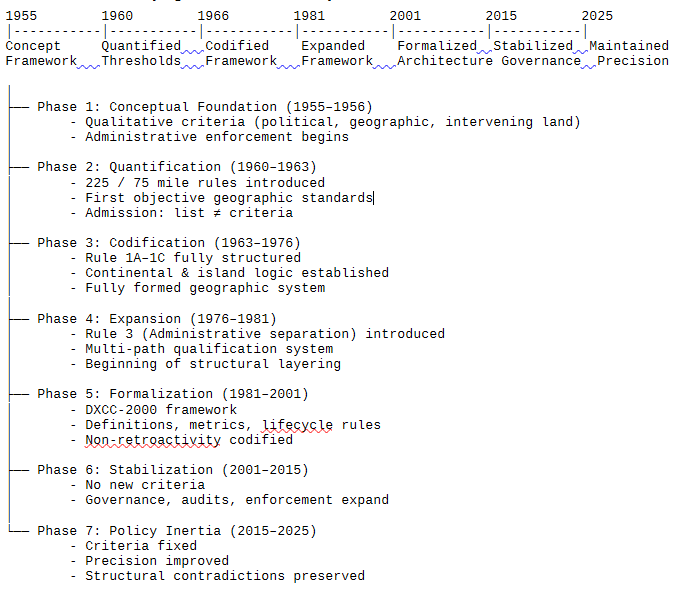
Concept → Enforcement → Quantification → Codification → Formalization → Stabilization → Inertia
I. VisualOVERVIEW TimelineOF (High-LevelSTRUCTURAL Evolution)EVOLUTION
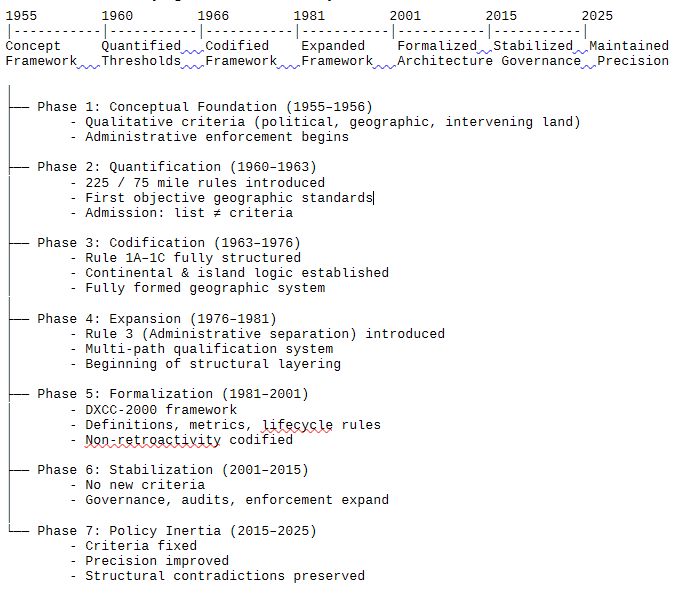
The
historical
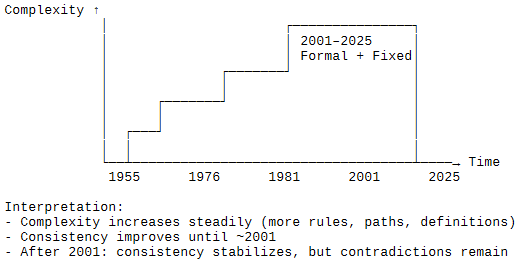
development II.of Structuralthe EvolutionDXCC Model
Rules A.between System1955 Complexityand vs.2025 Consistency
reflects 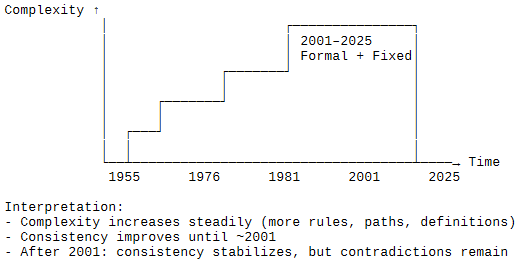
a
progressive B.evolution Systemthrough Characterseveral Transformationdistinct phases:
Era
SystemDominant Character
Primary DriverCharacteristic
1955–1960
Conceptual
conceptual and
Expert judgmentinterpretive
1960–1976
Analytical
quantitative and
Quantitative rulesanalytical
1976–1981
Layered
Multiplelayered qualification pathsexpansion
1981–2001
Formalized
Structuredformalized criteria architecture
2001–2025
Stabilized
Governancegovernance and enforcementstructural stabilization
III.II. ThreeTHREE CriticalMAJOR InflectionINFLECTION PointsPOINTS
1. 1960Quantitative —Clarification Quantification(1960)
“AdequateThe separation”introduction becomesof measurable geographic thresholds transformed earlier qualitative concepts into operationally applicable criteria.
Historical significance:
2. 1981Qualification —Path Expansion (1981)
Administrative distinction becomesbecame an independent qualification pathway alongside political and geographic qualification.
Historical significance:
3. 2001Formalized —Criteria FormalizationArchitecture (2001)
DXCCThe becomesDXCC2000 aframework structured criteria systemintroduced:
Historical
4. Post-2001 — Stabilization
System stops evolving structurallysignificance:
IV.III. CoreFINAL StructuralSTRUCTURAL Model (Final State)MODEL
By 2025, the DXCC system operates asthrough athe three-layerinteraction hybridof system
:three principal components:
Era
SystemDominant Character
Primary DriverCharacteristic
1955–1960
Conceptual
Expert judgmentinterpretive
1960–1976
Analytical
Quantitative rulesanalytical
1976–1981
Layered
Multiplelayered qualification pathsexpansion
1981–2001
Formalized
Structuredformalized criteria architecture
2001–2025
Stabilized
Governancegovernance and enforcementstructural stabilization
|
|
Function |
|
|---|---|---|
|
|
|
|
|
DXCC List |
|
|
|
Precedent and interpretation |
| and resolve
|
This structure reflects both:
IV. CENTRAL HISTORICAL OBSERVATION
Across the full historical arc, DXCC evolution demonstrates increasing:
At the same time, the system continued to preserve:
As a result, the DXCC framework evolved into a historically layered system rather than a purely self-contained rule structure.
V. TheHISTORICAL Central Structural RealitySIGNIFICANCE
ThenThe vs.evolution Nowof the DXCC Rules reflects not merely the development of qualification criteria, but the gradual transformation of the program itself:
|
|
|
|
|---|---|---|
|
|
| how qualification
|
|
|
|
|
|
|
|
By the post-2000 period, the framework had become:
while still reflecting the historical accumulation of earlier qualification methodologies.
VI. DXAC-LEVEL SYNTHESIS
The full historical arc demonstrates a clear progression:
|
Phase |
Character |
|
|---|---|---|
|
1955–1976 |
|
|
|
|
|
|
|
|
|
|
|
2001–present |
|
VI. The Irreduciblemodern Tension
DXCC 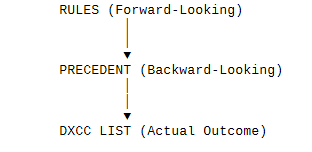
Result:therefore reflects:
operating together within a historically evolved framework.
VII. DXAC-LevelFINAL SynthesisOBSERVATION
The fullhistorical arcevolution (1955–2025)of the DXCC Rules demonstrates athat clearthe progression:program gradually evolved from:
while simultaneously preserving substantial continuity with earlier interpretations and historically recognized entities.
This layered historical development is essential for understanding both:
Final Insight
The DXCC system has reached maximum structural maturity—but not structural unity.
VIII. Direct Implication for Reform (v24q Context)
This arc leads to a single unavoidable conclusion:
Incremental refinement can no longer resolve DXCC inconsistencies.
Because:
Therefore:
Meaningful reform must be structural, not incremental.
IX. One-Line Summary for Presentation Slide
“DXCC evolved from judgment → rules → structure → governance—but never achieved full internal consistency. The system is now stable, but structurally constrained.”