
ARRL DX Century Club (DXCC) Rules — 1955-2015/25 Analysis
ARRL DXCC Rules Change Analysis
Full Arc Synthesis (1955–2025)
Concept → Enforcement → Quantification → Codification → Formalization → Stabilization → Inertia
I. Visual Timeline (High-Level Evolution)
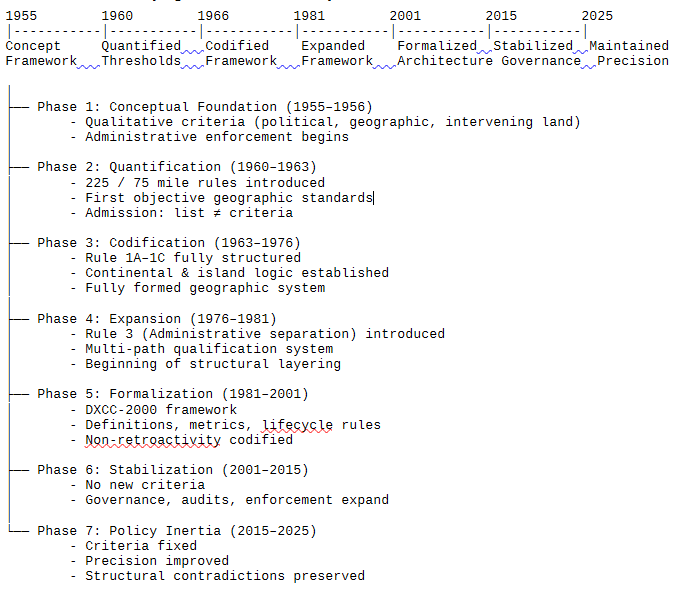

1955 1960 1966 1981 2001 2015 2025│-----------│-----------│-----------│-----------│-----------│-----------│Concept Quantified Codified Expanded Formalized Stabilized MaintainedFramework Thresholds Framework Framework Architecture Governance Precision│├──Phase 1: Conceptual Foundation (1955–1956)│- Qualitative criteria (political, geographic, intervening land)│- Administrative enforcement begins│├──Phase 2: Quantification (1960–1963)│- 225 / 75 mile rules introduced│- First objective geographic standards│- Admission: list ≠ criteria│├──Phase 3: Codification (1963–1976)│- Rule 1A–1C fully structured│- Continental & island logic established│- Fully formed geographic system│├──Phase 4: Expansion (1976–1981)│- Rule 3 (Administrative separation) introduced│- Multi-path qualification system│- Beginning of structural layering│├──Phase 5: Formalization (1981–2001)│- DXCC-2000 framework│- Definitions, metrics, lifecycle rules│- Non-retroactivity codified│├──Phase 6: Stabilization (2001–2015)│- No new criteria│- Governance, audits, enforcement expand│└──Phase 7: Policy Inertia (2015–2025)- Criteria fixed- Precision improved- Structural contradictions preserved
II. Structural Evolution Model
A. System Complexity vs. Consistency
Complexity ↑│ ┌───────────────┐│ │2001–2025 ││ │Formal + Fixed││ ┌───────┘ ││ │ ││ ┌───────┘ ││ │ ││ ┌───┘ ││ │ │└──┴───────────────────────────────────┴────→Time1955 1976 1981 2001 2025Interpretation:- Complexity increases steadily (more rules, paths, definitions)- Consistency improves until ~2001- After 2001: consistency stabilizes, but contradictions remain
B. System Character Transformation
|
Era |
System Character |
Primary Driver |
|---|---|---|
|
1955–1960 |
Conceptual |
Expert judgment |
|
1960–1976 |
Analytical |
Quantitative rules |
|
1976–1981 |
Layered |
Multiple qualification paths |
|
1981–2001 |
Formalized |
Structured criteria architecture |
|
2001–2025 |
Stabilized |
Governance and enforcement |
III. Three Critical Inflection Points
1. 1960 — Quantification
“Adequate separation” becomes measurable
-
First objective thresholds
-
Beginning of rule-based analysis
2. 1981 — Expansion
Administrative distinction becomes an independent pathway
-
System shifts from unified → layered
-
Multiple qualification paths introduced
3. 2001 — Formalization
DXCC becomes a structured criteria system
-
Definitions, metrics, lifecycle rules
-
Non-retroactivity explicitly codified
4. Post-2001 — Stabilization
System stops evolving structurally
-
Governance replaces rule development
-
Inertia begins
IV. Core Structural Model (Final State)
By 2025, DXCC operates as a three-layer hybrid system:
|
Layer |
Function |
Behavior |
|---|---|---|
|
Criteria |
Define qualification rules |
Precise, forward-looking |
|
DXCC List |
Establish actual entities |
Historical, non-uniform |
|
Precedent |
Preserve continuity |
Overrides strict rule application |
V. The Central Structural Reality
Then vs. Now
|
Aspect |
Pre-2001 |
Post-2001 |
|---|---|---|
|
Rule Evolution |
Active |
Frozen |
|
Criteria Precision |
Increasing |
Maximized |
|
System Flexibility |
High |
Constrained |
|
Governance Role |
Limited |
Dominant |
|
Structural Consistency |
Improving |
Fixed (but imperfect) |
VI. The Irreducible Tension
RULES (Forward-Looking)││▼PRECEDENT (Backward-Looking)││▼DXCC LIST (Actual Outcome)
Result:
-
Rules define how new entities qualify
-
Precedent defines what remains
-
The List reflects both—and fully aligns with neither
VII. DXAC-Level Synthesis
The full arc (1955–2025) demonstrates a clear progression:
-
Framework Creation (1955–1976)
-
Framework Expansion (1976–1981)
-
Framework Formalization (1981–2001)
-
Framework Stabilization (2001–Present)
Final Insight
The DXCC system has reached maximum structural maturity—but not structural unity.
-
The rules are complete
-
The system is stable
-
The inconsistencies are permanent under current design
VIII. Direct Implication for Reform (v24q Context)
This arc leads to a single unavoidable conclusion:
Incremental refinement can no longer resolve DXCC inconsistencies.
Because:
-
Criteria are already precise
-
Exceptions are already formalized
-
Non-retroactivity prevents reconciliation
Therefore:
Meaningful reform must be structural, not incremental.
IX. One-Line Summary for Presentation Slide
“DXCC evolved from judgment → rules → structure → governance—but never achieved full internal consistency. The system is now stable, but structurally constrained.”